Canada-China Trade Deal 2026: The Complete Buying Guide for Importers
Canada-China Trade Deal 2026: The Complete Buying Guide for Importers
The Canada-China trade deal, formalized as a preliminary agreement-in-principle on January 16, 2026, is the most significant reset of Sino-Canadian trade relations in nearly a decade. For overseas buyers, importers, and DTC store owners actively sourcing from China, this deal changes the tariff math, opens new commodity corridors, and signals a geopolitical thaw that makes China-based supply chains more defensible to plan around.
This guide is for purchase-stage readers — not policy wonks. If you're deciding whether to expand your China sourcing program, lock in a factory partner, or restructure your supplier mix in response to the deal, this is what you need to know.
Who This Guide Is For
You're an importer, a DTC brand owner, or a procurement manager who sources physical goods from China and is actively evaluating whether the Canada-China trade deal changes your supplier strategy. Maybe you've been hedging toward Vietnam as a manufacturing base to avoid trade friction. Maybe you're a Canadian buyer who watched canola tariffs spike to roughly 85% and got burned. Or you're an overseas buyer watching Canada and China re-engage and wondering what the gating conditions are before you commit to a new factory relationship. This guide gives you a concrete framework to evaluate the deal's implications, choose the right sourcing structure, and ask the right questions before you sign a purchase order.
What the Canada-China Trade Deal Actually Does
Skip the diplomatic language. Here's what changed for buyers.
PM Carney's January 2026 Beijing visit — the first by a Canadian Prime Minister since 2017 — produced a bilateral agreement with three actionable outcomes for trade:
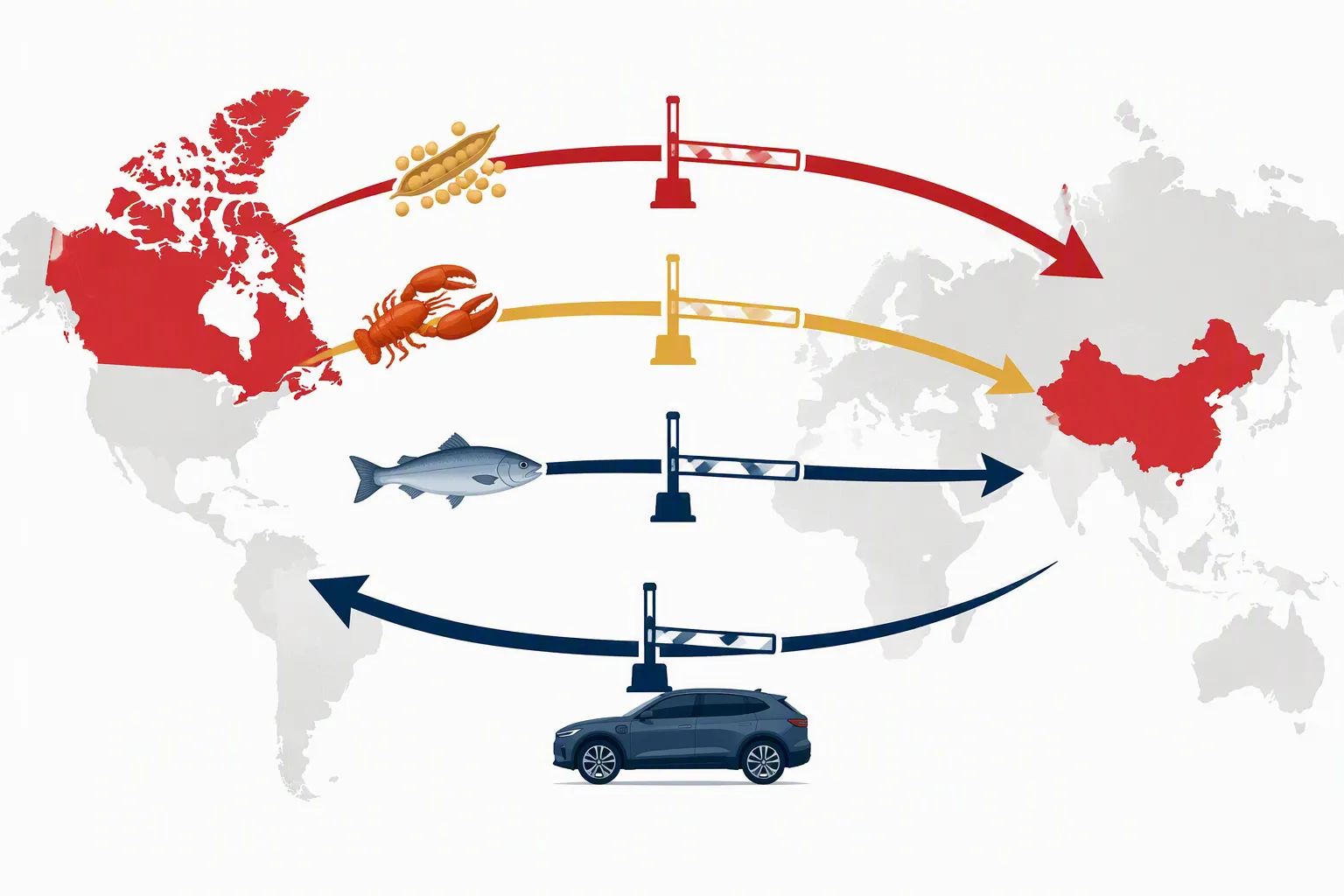
1. Canadian agricultural exports get preferential access. China dropped retaliatory tariffs on Canadian canola seed from a combined ~85% to approximately 15% by March 1, 2026. Canola meal, lobsters, crabs, and peas were exempted from anti-discrimination tariffs through at least year-end 2026. China is a $4 billion canola seed market for Canadian producers, and the tariff cut unlocks most of it.
2. Chinese EVs gain a controlled entry point into Canada. Up to 49,000 Chinese electric vehicles per year may enter Canada at the most-favoured-nation rate of 6.1% — below prior retaliatory levels. That quota represents less than 3% of annual Canadian vehicle sales, and more than half are projected to be sub-$35,000 affordable EVs within five years.
3. The deal targets nearly $3 billion in export orders for Canadian businesses and sets up joint-venture investment in Canadian auto manufacturing. Both governments describe energy, clean technology, batteries, solar, and wind as priority cooperation sectors.
The joint statement released by Carney and President Xi Jinping frames this as a strategic partnership, not just a tariff swap. For importers, that matters: it signals China is actively de-escalating trade friction with Western partners who are willing to engage.
Key Decision Factors for Importers
1. Tariff Impact on Your Specific Product Category
Not every product category benefits equally from this deal. The immediate wins are in agriculture (canola, seafood) and EVs. For manufactured goods importers, the deal's main value is signal-level: it shows both governments are committed to reducing friction, which makes long-term factory contracts less risky.
What "good" looks like: you've mapped your product's HS code against current MFN rates, confirmed no retaliatory surcharges apply, and verified the March 2026 tariff schedule changes before locking in pricing.
2. Supplier Reliability and Factory Vetting
Tariff windows open and close. A factory relationship that produces consistent quality and meets delivery timelines survives multiple trade cycles. The biggest sourcing mistake importers make after a deal announcement is rushing to onboard new factories without proper vetting — chasing lower prices through an unfamiliar gating process with no quality checks built in.
What "good" looks like: your factory has been physically audited, has certifiable capacity for your volume, and a track record you can verify — not just a Alibaba gold-supplier badge.
3. MOQ and Price Negotiation Room
The Canada-China deal creates new leverage for buyers willing to show long-term commitment. Chinese factories currently competing for diversified export markets — particularly those that lost volume to Vietnam-based alternatives during peak trade tension years — are more negotiable on minimum order quantities and unit pricing than they were in 2023.
Ask prospective factories what their current utilization rate is. A factory running at 60–70% capacity has more negotiating room than one running at 95%. Request current MOQ tiers and a volume-based pricing ladder before discussing samples.
4. Sample Coordination and Lead Times
The deal does not affect production lead times. China's manufacturing calendar — Golden Week, Lunar New Year, factory audit cycles — still applies. What changes with a better trade relationship is the willingness of factories to prioritize export-oriented buyers.
What "good" looks like: sample lead time confirmed in writing, production lead time broken out by phase (raw material, production run, QC, freight), and a contact at the factory who can give you real-time updates — not just a sales rep who goes silent after payment.
5. Supply Chain Diversification vs. Concentration
Some buyers moved sourcing to Vietnam or other Southeast Asian markets during the Canada-China trade war years. The 2026 deal does not mean you abandon that diversification — it means the calculus changes. China still offers unmatched manufacturing depth in electronics, machinery components, textiles, and clean tech. Vietnam offers competitive labor costs for certain apparel and furniture categories.
A practical approach: keep Vietnam capacity for categories where it's genuinely cost-competitive, and re-engage China for categories where the manufacturing ecosystem (tooling, component supply chains, specialized labor) is irreplaceable.
6. Compliance, Certifications, and Import Documentation
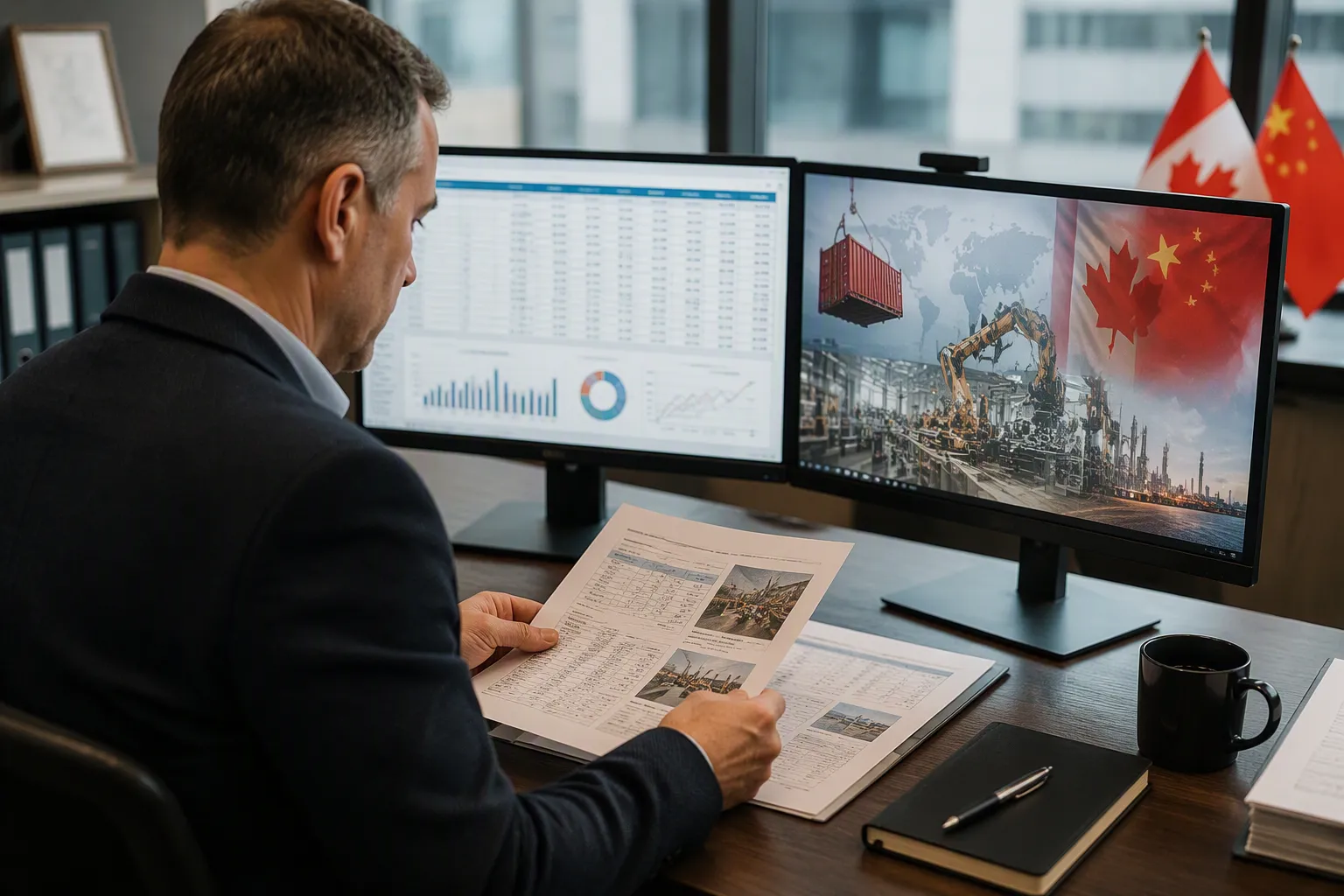
A lower tariff rate only benefits you if your import documentation is clean. Chinese factories vary widely in their ability to produce compliant export documentation — certificates of origin, conformity documents, and product safety certifications your destination market requires.
What "good" looks like: factory provides country-of-origin documentation that matches actual production location, product certifications are current and verifiable (CE, FCC, CSA, as applicable), and the factory has a documented QC process you can audit.
7. Communication and Language Infrastructure
Most of the friction in China sourcing is communication friction. Specifications get lost in translation, revision requests arrive ambiguous, and factory contacts don't always have authority to make the changes you're asking for. If you're managing this directly from Canada or another English-speaking market, budget for this friction or eliminate it structurally.
What "good" looks like: you have a bilingual point of contact who speaks the factory's language, understands your product specs, and can represent your quality expectations on-site when needed.
8. Sourcing Partner vs. Direct Factory Engagement
For buyers doing fewer than 10 factory relationships at a time, a managed sourcing partner typically outperforms direct factory engagement on both cost and time. You skip the false starts, the ghost factories, and the sourcing trips that show you a representative showroom rather than actual production conditions.
A sourcing partner like Link4a handles supplier shortlisting, factory vetting, MOQ and price negotiation, sample coordination, and repeat ordering — with multilingual communication built in. For Chinese factory owners, the inverse service exists: a managed overseas storefront that handles buyer conversations and marketing in six languages, with commission charged only on closed orders.
Budget Tiers for China Sourcing Engagement
| Tier | Typical Annual Import Volume | What You Get | Sourcing Approach |
|---|---|---|---|
| Entry | Under $50,000 | Access to vetted factory shortlists, basic MOQ negotiation, sample coordination | Managed sourcing partner on commission; minimal upfront spend |
| Mid-market | $50,000–$500,000 | Dedicated factory relationships, price renegotiation on repeat orders, QC coordination, multilingual factory comms | Hybrid: sourcing partner for new categories, direct on proven factories |
| Growth | $500,000–$2M | On-site factory audits, capacity reservation, custom packaging and compliance support, freight consolidation | Sourcing partner with embedded oversight or in-market agent |
| Enterprise | $2M+ | Joint-venture or co-investment structures, bonded factory programs, custom compliance pipelines, dedicated staff in China | In-house procurement team or full-service trade operator |
Entry-level buyers especially benefit from the Canada-China deal's signal value: factories that previously prioritized large Western buyers are more open to smaller accounts from importers operating in stable-relationship markets.
Red Flags to Avoid
- A factory that can't show you its actual production floor — only a trade show display or a product catalog. If they won't show production, you don't know what you're buying.
- A sourcing agent who quotes from marketplaces rather than direct factory relationships. Marketplace pricing has a middleman margin baked in. Real sourcing means direct factory access.
- A supplier promising tariff exemptions they can't document. Post-deal, the number of factories claiming preferential treatment will spike. Ask for the certificate of origin and have it independently verified.
- No English-language QC checklist or inspection criteria before production starts. Verbal agreements on quality produce disputes, not products.
- Lead times quoted without a production schedule breakdown. "6–8 weeks" means nothing without knowing when raw material procurement starts and when your slot is confirmed.
- A sourcing partner who charges large upfront retainers without any performance accountability. Commission-only or milestone-based models align incentives better.
- Price quotes that don't separate unit cost, tooling, packaging, and freight. Bundled quotes obscure where your money is going and make negotiation impossible.
Buying Process Checklist
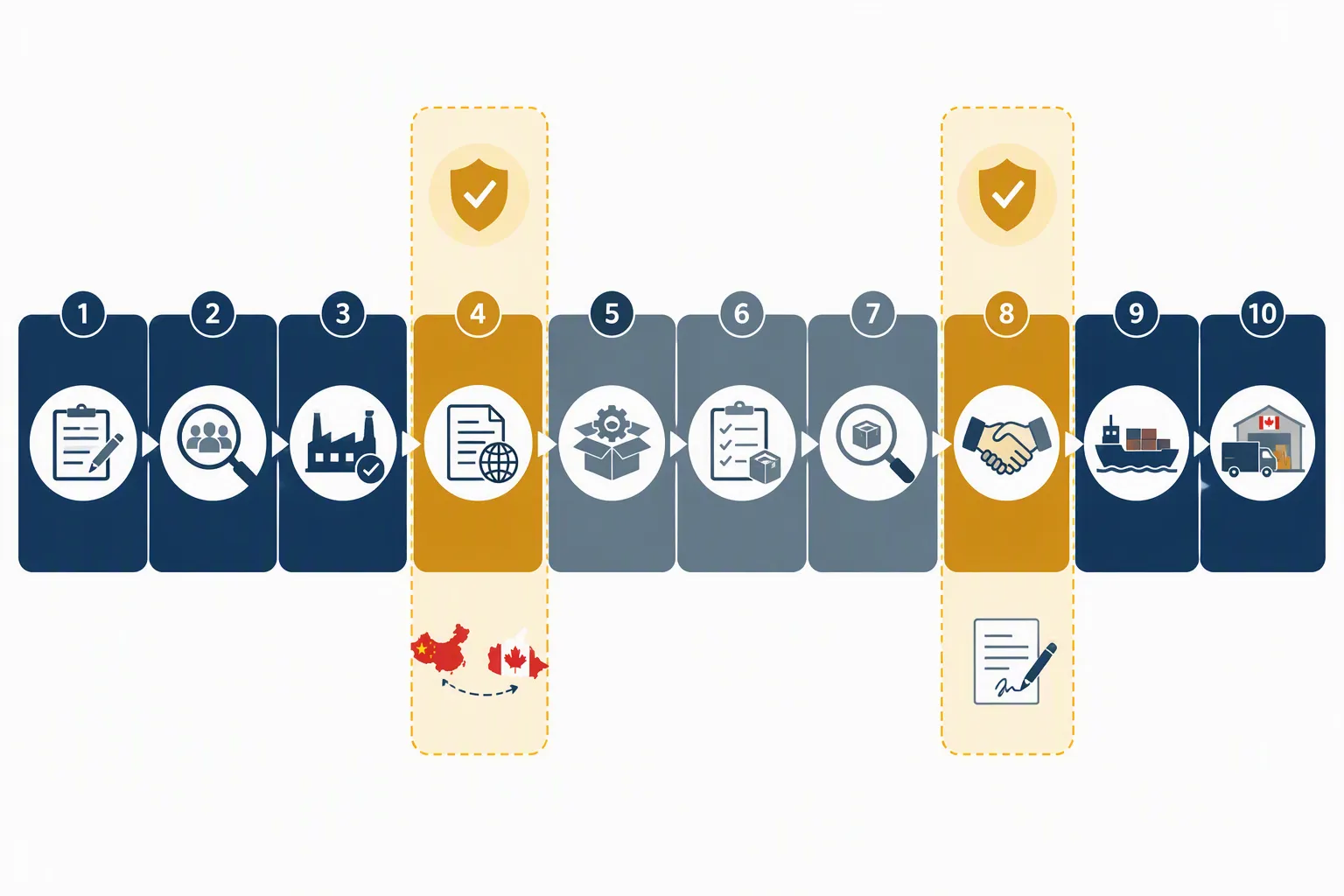
Follow these steps in order. Skipping ahead — especially past factory vetting — is where most sourcing problems originate.
- Define your product requirements — specifications, target unit cost, volume, destination market, and required certifications. Write this down before any factory conversations.
- Map your tariff position — identify your product's HS code, check current MFN rates, and confirm whether any Canada-China deal provisions affect your category. Cross-reference the Canada-China Preliminary Agreement-in-Principle for sector-specific details.
- Shortlist factories or a sourcing partner — use at minimum three options. For direct factory engagement, verify business registration, export license, and production capacity. For sourcing partners, ask for a verifiable client reference and documented factory audit process.
- Request samples with a written specification brief — not a verbal description. Attach photos, dimensions, material requirements, and packaging specs. Evaluate sample quality against your spec, not against the sample itself.
- Negotiate MOQ, pricing, and lead time in writing — get a proforma invoice before committing. Clarify what happens if production is delayed or quality fails inspection.
- Conduct a pre-production quality check — either in-person, via a third-party QC firm, or through a sourcing partner with on-ground oversight. Do this before full production runs, not after.
- Run reference checks on your factory or sourcing partner — speak to at least two existing buyers. Ask specifically about on-time delivery rate and how quality disputes were resolved.
- Negotiate contract terms — payment schedule, inspection rights, defect remediation policy, and what happens if a tariff rate changes mid-order. Don't skip this for repeat orders.
- Place initial order and monitor production milestones — request mid-production photos or an inspection report at the 50% production mark.
- Evaluate post-delivery — defect rate, packaging integrity, documentation completeness. Use this to inform your next negotiation cycle.
Questions to Ask Vendors and Sourcing Partners
Before signing anything, put these questions in front of every factory or sourcing agent you're evaluating:
- What is your current factory utilization rate, and what production capacity can you allocate to my order?
- Can you provide a certificate of origin and export documentation that satisfies Canadian and/or my destination market customs requirements?
- What is your minimum order quantity, and how does unit pricing change at [2x] and [5x] that volume?
- What certifications does this product carry (CE, FCC, CSA, RoHS, or other applicable standards), and are they current?
- How do you handle a quality dispute — specifically, what is your defect rate threshold and what remediation do you offer?
- What is your production lead time broken out by phase: raw material, production run, QC, and freight-ready?
- Do you have existing buyer references in my destination market I can contact directly?
- How do you communicate mid-production updates — what format, what frequency, and who is my point of contact?
- If I'm sourcing through a partner rather than direct: how many factories are in your vetted network for my product category, and what does your vetting process look like?
- What happens to my pricing and lead time if I place a repeat order within 90 days versus 6 months?
- Have you worked with buyers affected by recent Canada-China trade friction, and how did you manage tariff changes mid-order?
- What is your payment structure — and what percentage is due before production starts?
Recommended Next Steps
The Canada-China deal unlocks real opportunity, but it doesn't source factories for you. The buyers who benefit most from this reset are the ones who move decisively on vetted factory relationships now — before the initial quota windows fill and before the political goodwill translates into higher factory order books and tighter MOQ flexibility.
If you're a Canadian importer, DTC brand, or overseas buyer ready to act on this trade reset, start by clarifying your product requirements and tariff position, then put at least three sourcing options in front of you before committing to any one path.
If you want a China sourcing partner who shortlists factories, runs the vetting process, negotiates MOQ and pricing on your behalf, and manages multilingual communication with the factory — without a large upfront retainer — Link4a works on a commission basis. For more on how U.S.-based importers can position themselves around the Canada-China deal, see Canada China Trade Deal: What U.S. Importers Need to Know in 2026.
Request a quote or ask about current factory availability at Link4a →
Facts and statistics in this guide are sourced from official Canadian government publications. Tariff rates and quota figures reflect the January 16, 2026 preliminary agreement-in-principle and may be updated as final agreements are ratified.